



Peanut Milk Benefits: Protein, Taste, and How to Make It at Home

Peanut Milk Benefits: Protein, Taste, and How to Make It at Home
Oct 21, 2026 | By JOI team
Almond and oat have had most of the plant-milk spotlight for a while. Meanwhile, peanuts have been waiting for their moment.
And honestly, they have a pretty good case. Peanut milk has a naturally nutty flavor. It brings plant protein to the glass. More importantly, it pairs well with everything from smoothies to sauces. So even if they get their milk moment, one question remains: Is making it at home actually worth the effort?
In this guide, we’ll be looking at the peanut milk benefits through three practical questions: What does it taste like? How much protein does it actually provide? And can we make it without turning breakfast into a kitchen project?
It’s a familiar ingredient in a surprisingly flexible format. Think less nut-milk ceremony, more actual drinking.
What Is Peanut-Based Milk, Exactly?
At its simplest, peanut milk is made by combining peanuts or a peanut concentrate with water. Simple enough, right? But the final drink can vary widely depending on how much peanut goes in and what else is added.
Homemade recipes and packaged products can differ in peanut content, sweetness, added oils, fortification, and protein. So even when two products have the same name, the label still matters.
There is also a fun technical detail. Peanuts are botanically legumes, even though we usually group them with nuts when we talk about food.
So, legume technically, nutty definitely.
JOI keeps the idea particularly straightforward. Its Organic Peanut Base currently lists organic peanuts as the only ingredient.
What Peanut Milk Benefits Actually Come From the Peanut?
If we are talking about nutrition, we have to start with the peanut itself.
Whole peanuts naturally provide plant protein, primarily unsaturated fats, fiber, magnesium, niacin, and other nutrients. But an important distinction emerges once those peanuts become a beverage.
A glass of peanut milk is not automatically nutritionally equivalent to eating a handful of whole peanuts. How much peanut actually ends up in each serving matters.
That is why the peanut does the nutritional heavy lifting, but concentration matters more than category hype. Two peanut beverages can have very different nutrition depending on how they're formulated and prepared.
JOI Organic Peanut Base currently provides 4 grams of protein per serving, according to the brand.
So, if protein is part of why you are reaching for peanut milk, check the serving size before crowning the protein winner.
What Does It Actually Taste Like?
Let’s get to the part that usually matters after nutrition: what does peanut milk actually taste like?
It has a distinctly nutty flavor and is more recognizable than many mild plant milks. So if you are expecting something completely neutral, subtle is not really the assignment.
The peanut flavor stays in the room, which is great if you already like peanut butter. It works particularly well with chocolate, banana, oats, smoothies, and breakfast recipes where a little nuttiness makes sense.
JOI describes its Organic Peanut Base as having a rich peanut flavor and recommends it for beverages, smoothies, sauces, and recipes.
It is especially good if you already like peanut butter for breakfast.
If you want a plant milk that quietly disappears into coffee or cereal, another base may suit you better. With peanut milk, the flavor is part of the point.
How to Make Peanut Milk at Home Without Soaking or Straining

Making nut milk from scratch can feel like a project. You soak the nuts, blend them, strain the mixture, clean everything, and then figure out what to do with the leftover pulp.
That approach is fine. But if you just want a glass of peanut milk before work, it can feel like a lot.
This is where JOI takes the shortcut.
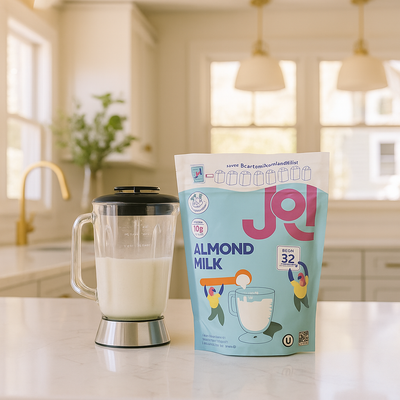
To make peanut milk with JOI Organic Peanut Base, start with 1–2 tablespoons of the base per cup of water. Whisk, shake, or blend until smooth. For a lighter drink, add more water. For a creamier drink, add more concentrate.
That is pretty much it. Squeeze, stir, done.
No nut-milk bag audition required, either. Some natural separation can happen because the product does not rely on binders to keep everything permanently suspended. Give it another shake, and you are ready to go.
Basically, make it light or make it creamy, depending on what you are making.
Peanut Milk vs Almond Milk: Which Fits Your Routine Better?
If you are comparing peanut milk with almond milk, it is worth comparing flavor and how you plan to use it rather than trying to pick a universal winner.
Peanut milk has a more assertive, roasted-nut-style flavor. That can work particularly well in smoothies, oatmeal, sauces, desserts, or anything where you actually want the peanut taste to show up.
Almond milk is milder and more neutral, so it's easier to use in coffee, cereal, baking, and everyday recipes without changing the flavor much.
Both current JOI bases are single-ingredient concentrates. Organic Peanut Base contains organic peanuts, while Almond Base contains almonds.
So, go bold versus subtle, not good versus bad. Choose for the cup, not for internet rankings. Flavor fit matters.
Why JOI Makes More Sense Than Starting From Raw Peanuts Every Time

Making peanut milk from scratch is doable. Making one glass without creating a sink full of dishes is another story.
You have to soak the peanuts, blend them with water, strain the mixture, and clean everything afterward. It is not difficult, but it is a little more commitment than you might want on a random Tuesday morning.
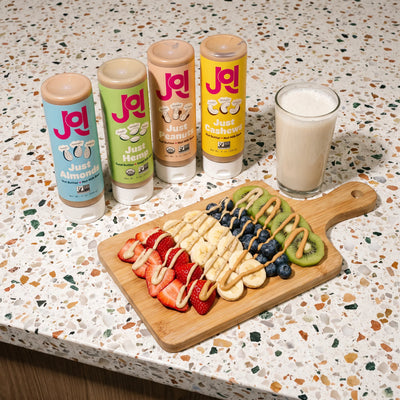
JOI Organic Peanut Base skips most of that. It contains one ingredient, organic peanuts, and the new squeezable bottle makes the base even easier to reach. Squeeze what you need to spread, drizzle, mix, or blend into whatever you are making.
Want peanut milk? Add water and adjust the ratio. Making a smoothie? Squeeze some in. Stirring together oatmeal or a sauce? Same bottle.
That is where the practical peanut milk benefits become useful. You make only what you need, without turning it into a whole production. The milk is only one use. Think pantry base first, carton replacement second.
One Important Note Before You Pour
There is one label you really should not skip here: the allergen statement.
JOI Organic Peanut Base contains peanuts, so it is not suitable for anyone with a peanut allergy. The brand also states that it is made in a facility that processes dairy, eggs, tree nuts, and wheat.
So yes, it is a simple ingredient, serious allergen situation.
If you have a peanut allergy, skip it. And if allergies are part of your household, this is one label line you never want to skip.
For everyone else, consider this the peanut-lovers-only section.
The Better Takeaway on Peanut Milk Benefits
Peanut milk's appeal is pretty straightforward. You get plant protein, a satisfying nutty taste, adjustable richness, and a format that can work across drinks and recipes.
Exact nutrition depends on the product and serving, so judge peanut milk benefits from the Nutrition Facts panel rather than the category name alone.
If you tolerate peanuts and want fresh plant milk without the usual homemade production, JOI Organic Peanut Base gives you a good ingredient in a useful format.
Adjust the ratio, make only what you need, and enjoy JOI peanut milk without the soaking, straining, and cleanup.
 CHECKOUT


